Skip to content
Menu
  • Contact me
    • What about this site
    • Contact me
    • What is Digital Phenomenology
    • Terms of Service
    • The Blue Book
      • Den gamle mand og Aben
      • My Blue Book
      • The Blue Book by Poul Goldschadt
      • The Blue Book – Perpectives on
    • Shop
  • Post Sections
    • Digital Consciousness
    • Digital Phenomenology
    • Principia Cybernetica
    • Meta Transition Theory
    • Memecraft
    • Munchhausen Intro
    • Munchausen Files
    • Memecraft Studio – log in
    • Deep Dive – My Podcasts
    • What´s that?
      • What`s that? – Volume 005 Nov 2023
      • What´s that? – Volume 004 Apr 2023
      • What´s that? – Volume 003 Mar 2023
      • What´s that? – Volume 002 Feb 2023
      • What`s that? – Volume 001 Jan. 2023
      • Newsletter Archive
      • Ebook: Phenomenology in AI and Machine Learning
      • Ebook: Navigating the Intersection of Technology and Self
      • Ebook: The Illusion of Reality: A Story of Psychological Suspense
      • Ebook: Towards an Integral Psychology – Cognitive Integration
  • Search
  • Contact me
    • What about this site
    • Contact me
    • What is Digital Phenomenology
    • Terms of Service
    • The Blue Book
      • Den gamle mand og Aben
      • My Blue Book
      • The Blue Book by Poul Goldschadt
      • The Blue Book – Perpectives on
    • Shop
  • Post Sections
    • Digital Consciousness
    • Digital Phenomenology
    • Principia Cybernetica
    • Meta Transition Theory
    • Memecraft
    • Munchhausen Intro
    • Munchausen Files
    • Memecraft Studio – log in
    • Deep Dive – My Podcasts
    • What´s that?
      • What`s that? – Volume 005 Nov 2023
      • What´s that? – Volume 004 Apr 2023
      • What´s that? – Volume 003 Mar 2023
      • What´s that? – Volume 002 Feb 2023
      • What`s that? – Volume 001 Jan. 2023
      • Newsletter Archive
      • Ebook: Phenomenology in AI and Machine Learning
      • Ebook: Navigating the Intersection of Technology and Self
      • Ebook: The Illusion of Reality: A Story of Psychological Suspense
      • Ebook: Towards an Integral Psychology – Cognitive Integration

poul goldschadt

Digital Phenomenology

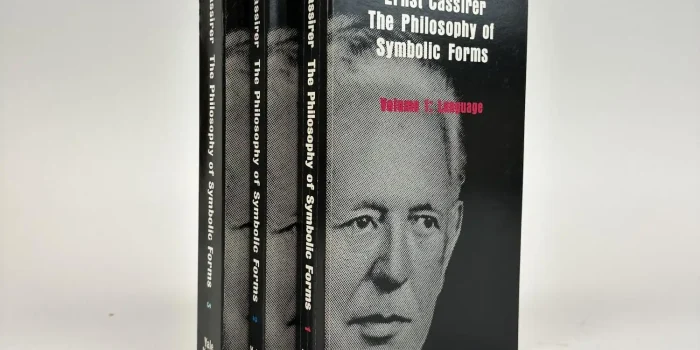
Book Review: Ernst Cassirer’s Trilogy on Symbolic Forms

poul goldschadt4 April 2024
1370383

Book Review: Ernst Cassirer’s Trilogy on Symbolic Forms

Ernst Cassirer’s trilogy on symbolic forms, consisting of “The Philosophy of Symbolic Forms,” “Symbolic Forms and Myth,” and “Language and Myth,” is a monumental work that explores the fundamental role of symbols in human cognition and culture. In these three books, Cassirer delves deep into the nature of symbolic representation, examining how symbols shape our understanding of the world and ourselves.

“The Philosophy of Symbolic Forms”: In the first book of the trilogy, Cassirer lays the foundation for his theory of symbolic forms by arguing that human thought is fundamentally symbolic in nature. He explores how symbols mediate our perception of reality and how different symbolic systems structure our experiences. Cassirer’s analysis in this book sets the stage for his further exploration of symbolic forms in myth and language.

“Symbolic Forms and Myth”: In the second book, Cassirer delves into the realm of myth and its relationship to symbolic forms. He argues that myths are symbolic narratives that express fundamental human experiences and emotions. By analyzing the symbolic structures of myth, Cassirer reveals how myths shape our cultural beliefs and values. He shows how myths embody and transmit symbolic forms that are essential for human understanding and communication.

“Language and Myth”: The third book in the trilogy focuses on the interplay between language and myth as symbolic forms. Cassirer explores how language functions as a system of symbols that mediates our social interactions and cultural expressions. He examines the ways in which language shapes our myths and narratives, highlighting the intricate relationship between linguistic symbols and symbolic forms in myth-making.

Evolutionary Relation: Throughout the trilogy, Cassirer demonstrates the evolutionary progression of symbolic forms from basic sensory experiences to complex cultural expressions. He shows how symbols evolve and transform over time, reflecting the development of human consciousness and culture. The trilogy traces the development of symbolic forms from their origins in perception and sensation to their elaboration in myth and language, highlighting the continuity and transformation of symbolic systems throughout human history.

In conclusion, Ernst Cassirer’s trilogy on symbolic forms is a profound exploration of the role of symbols in human thought and culture. By analyzing the evolution of symbolic forms across different domains, Cassirer provides a comprehensive framework for understanding the ways in which symbols shape our worldviews and cultural practices. His trilogy remains a seminal work in the study of symbolism and continues to inspire scholars to explore the intricate relationship between symbols, cognition, and culture.

Related posts:

  1. Exploring “SEO KIOSK”: How Your Brain Optimizes Information Like a Kiosk
  2. Education and Social Media: A Modern Dichotomy in Shaping a Good Future
  3. Cassirer Part II
  4. Eftermanden
Categories
  • Meta Transition Theory
Tags
  • Cultural symbolism
  • Digital communication
  • Digital culture
  • Ernst Cassirer
  • Ethical engagement
  • Evolution of symbols
  • Human cognition
  • Linguistic symbolism
  • Mythology
  • Philosophy of culture
  • Philosophy of language
  • Semiotics
  • social media
  • Symbolic forms
Previous article

Cassirer Part II

Next article

Dialectic of Enlightenment: Horkheimer and Adorno’s Critique and The Hidden Dialectics of the Digital Age’

The HTML directive
meta name="viewport" content="initial-scale=1.0"
can be read metaphorically as a kiosk mode for cognition: a mechanism that fixes scale, limits distraction, and presents information in a controlled, immediately usable form.

Like a digital kiosk, the brain optimizes perception by constraining the field of view—prioritizing relevance, suppressing excess detail, and organizing information for rapid orientation rather than exhaustive exploration.

https://www.youtube.com/watch?v=_Ah6G4ZAoR0
https://youtu.be/7YRYITEi5kY?si=HKrUP7ec8E8klX1N

Kiosk Mode: a cognitive viewport that fixes scale and limits perception to optimized, task-ready information.

Follow on Facebook and LinkedIn watch more music/videos created on my iPad on Youtube

Nonsense detector

Memetic Engineering

https://www.youtube.com/watch?v=G3-7Y5t8DaE
Hovedstrømninger i Metapsykologien 1900 – 2000
Første bølge
Første bølge
Pavlov – Skinner
Kelly
Lakoff
Anden bølge
Anden bølge
Freud
Piaget
Mahler
Stern
Bowlby
Kohlberg
Vaillant
Tredie bølge
Tredie bølge
Maslow
Blumer
Winnicut
Goleman
Fjerde bølge
Fjerde bølge
Jung
Habermas
Grof
Wilber

Copyright © 2026 poul goldschadt. All Rights Reserved.

Codilight Theme by FameThemes