

Nietzsche’s Will to Power vs. Schopenhauer’s Will: An Analytical Examination
Nietzsche and Schopenhauer, two prominent philosophers of the 19th century, proposed contrasting views on the nature of human desires and motivations. Nietzsche's concept of the "Will to Power" emphasizes the potential for growth and self-actualization, while Schopenhauer's notion of the "Will" suggests that human desires are ultimately futile and lead to suffering. This article aims to provide an analytical examination of these philosophical ideas, exploring their implications for human existence and the pursuit of happiness.
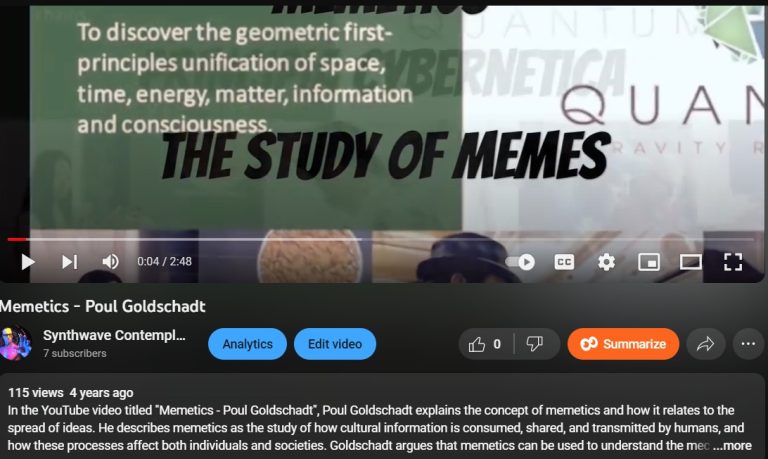
Mastering Memetics: Unleashing the Power of Ideas
Memes have become an integral part of our digital lives. From the sarcastic Grumpy Cat to the iconic Pepe the Frog, memes capture cultural references and spread them rapidly across the internet. But memes go beyond online humor; they shape our attitudes and opinions. Take, for example, political memes that satire politicians or highlight societal issues. These memes not only provide comic relief but also serve as a powerful tool for social and political commentary.

Digital Phenomenology and the Hard Problem of Consciousness
The hard problem of consciousness is one of the most challenging problems in philosophy and science. It is the problem of explaining why and how physical processes give rise to subjective experience. In other words, why do we have qualia,…

SEO, Viewports & Memes
SEO, Viewports & Memes The word meme originated with Richard Dawkins’ 1976 book The Selfish Gene. Dawkins wrote that evolution depended not on the particular chemical basis of genetics, but only on the existence of a self-replicating unit of transmission—in the case of biological…

Memetics – concepts, models, constructions, diagrams, objects, and things.
Memetics – concepts, models, constructions, diagrams, objects, and things. “Understanding the Construction of the Self and Cognitive Processes” A methodological field is presented inspired by developmental psychology, psychoanalysis, cognitive psychology, sociology, anthropology, existential-phenomenological psychology, transpersonal neuro-psychology. Ongoing metaphor: the Hegelian…

Virtual Technology & Digital Consciousness
Digital phenomenology is a field of study that analyzes the impact of digitization on human experience and perception. It is a branch of phenomenology, which is a philosophical approach that focuses on the study of human experience and consciousness. Digital…

Books on Digital Phenomenology
Digital phenomenology is an emerging field of philosophy that explores the nature of human experience in the digital age. It seeks to understand how our interaction with digital technologies influences our perception, cognition, and existence. Several key concepts and discussions…

What is AI Panic all about
The rise of AI has also brought forth a unique set of challenges, one of which is the pervasive fear of AI, often referred to as "AI panic." In this comprehensive exploration, we delve deep into the heart of AI panic, dissecting its roots, its implications, and its place in our ever-evolving digital landscape.

What`s in a name ?
Me: Tell me how the concept SEO KIOSK defined by Poul Goldschadt on his website and the science of digital phenomenology are related ChatGPT I don’t have direct access to Poul Goldschadt’s specific website or content, as it’s outside of…

What is Metaname = Viewport ?
The meta tag with the name “viewport” in HTML serves as a crucial tool for controlling how a webpage is displayed on different devices and screens. To explain its meaning metaphorically, let’s imagine you are an artist creating a masterpiece…

William James and his book principles of psychology
William James was an American philosopher and psychologist who lived from 1842 to 1910. He was one of the most influential thinkers of his time and is often referred to as the “Father of American Psychology.” One of his most…

Common misconceptions about Digital Phenomenology
Digital phenomenology is a relatively new and complex area of study that explores the ways in which digital technology affects human experiences and perception of the world. As I see it, there are several common misconceptions about this field that…

Scene of a Classroom
Here’s a scene of a classroom with a teacher and 30 students learning how to write prompts using ChatGPT: The bell rings and the students start to file into the classroom, taking their seats and getting out their laptops. The…

What´s that? – Volume 002 Feb 2023
What is “kiosk mode” Kiosk mode refers to a software setting that restricts a device’s functionality to a specific application or set of applications. In this mode, the device is locked down so that users cannot access any other…
Most influential Psychologists 1900 – 2000
Here is a list of influential psychologists, grouped by their wave of influence: First Wave: Wilhelm Wundt, Ivan Pavlov, John Watson, B.F. Skinner, Gordon Allport, Jean Piaget, Aaron Beck, Howard Gardner, Second Wave: Sigmund Freud, Alfred Adler,…