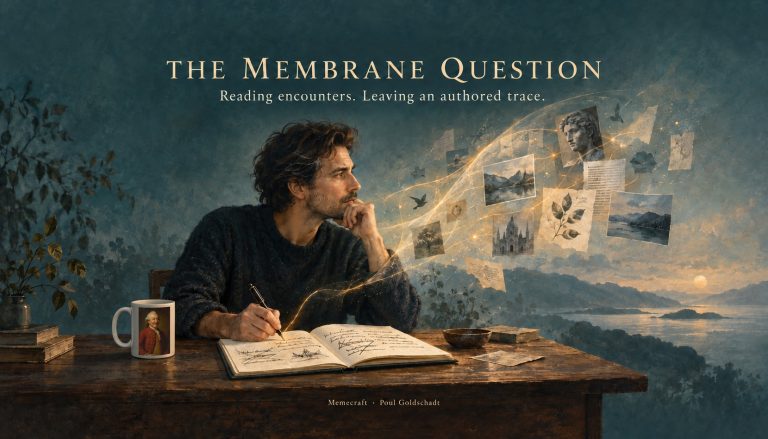

The Viewport: From Encounter to Judgment
Initial State 1, the cusp, and the educational task of becoming answerable for our judgments.
A screen offers something to see, something to believe, something to do. We arrive with expectations, memories, habits, and concerns. In their meeting, something becomes significant enough to guide a response. Digital phenomenology investigates that formation: how an appearance acquires weight, becomes intelligible, and enters the world through which we act.
Memecraft brings this inquiry into education. Its goal is den myndige borger: a person capable of informed, independent judgment who can use the help of others and of machines while remaining answerable for what they accept and do.
1. The Viewport: Where Possibility Meets Expectation
The user returns to the screen. Perhaps a new window has opened; perhaps the screen has remained unchanged while attention wandered. Something becomes discernible again. Viewport: Initial State 1 names this first available configuration of the encounter—the situation from which something can become identifiable, significant, and actionable.
“Initial” names an opening or renewal of contact. Returning from daydreaming makes it familiar: the surroundings were there, but now they become present to us again. Reorientation after intoxication can also illustrate this return, although it may unfold gradually. “1” identifies the opening state of the encounter under way, rather than its position in a numbered series. The person returns with a history; nothing requires an empty or neutral starting point.
The screen also carries a history. Its arrangement reflects code, design decisions, algorithmic selections, and previous interactions. The user brings bodily condition, memory, language, habits, desires, fears, and commitments. What appears and what is expected meet within the encounter.
A field of opportunities meets a field of expectations.
These fields are already entangled. Earlier choices may have helped shape the present display; earlier encounters may have taught the user what to expect. The screen offers possibilities partly organised around a model of the person. The living person can recognise those possibilities, misunderstand them, resist them, or discover something the model did not anticipate.
Resonance is the felt weighting of this meeting. It participates in what comes forward as relevant and what recedes into the background. A sentence can appear as reassurance, an insult, an invitation, or a threat. Its significance forms through the relation between what is encountered and the life in which it is encountered.
The cusp names the unsettled meeting at which possibilities acquire a direction for this person. Something becomes compelling enough to answer, pursue, refuse, or question. A decision gives that direction practical consequences. The click is one visible expression of the encounter; the meaningful event cannot be located in the mouse button alone.
A dog snarls and bares its teeth. An attack has not occurred; the encounter may still develop in different directions. For the person facing the dog, these possibilities have immediate bodily weight. Distance, posture, remembered encounters, and the possibility of injury shape what becomes discernible and how it matters. Resonance is present in that apprehension: the tightening body, the arrested movement, the urgency of what might happen next.
The person’s response becomes part of the situation the dog encounters, just as the dog’s next movement changes the person’s expectations. A direction is taking shape through their interaction while the outcome remains open. A response may begin before deliberate reflection is possible.
“Vanilla or strawberry?” reveals another aspect of the same structure. The offer presents an organised field of possibilities. The child’s remembered tastes, present desire, and expectations give those possibilities weight. “Chocolate!” reveals that the offered field and the expected field do not coincide. Their difference becomes expressible and may change the situation. Whether chocolate is available remains something to discover.
A decision carries the encounter forward. It may alter the display, reinforce an expectation, prompt another person’s response, or become evidence for a system’s next selection. What has happened enters the history from which the next situation will be encountered. Through symbolic articulation and storytelling, such encounters contribute to a world in which the person can orient and act.
Within this framework, Collapse names the standing awareness–appearance relation through which something becomes differentiated. It is not the first step in a chronological chain. Within livable time, Initial State 1, felt resonance, and symbolic articulation belong to an ongoing reciprocal relation. Meaning and storytelling organise a livable world, which in turn shapes subsequent encounters.
This is a phenomenological account, not a proposed mechanism of physical quantum collapse. The computer provides a metaphor for situated access: even examining code requires a view through which it becomes readable. Rendering explains how a display is produced; it does not by itself explain why that display matters to someone.
Nor does resonance guarantee truth. Meaning may become sufficiently stable for action, but stability can also take the form of prejudice, compelling nonsense, or premature certainty.
2. The Pause: Questioning the Menu
The offered frame and our response to it can become objects of examination. A student encountering an AI answer, a search result, or an assignment can ask how some possibilities became prominent while others remained unmentioned. The student can also examine why these particular possibilities seemed natural, convincing, or worth pursuing.
The Pause, or Human Interval, creates room for this examination within the encounter. It may arise before the next click or interrupt a response already under way. Its purpose is to keep the developing interpretation open long enough to reconsider it.
The Pause creates two distances. The first is distance from the offered menu:
- Who built this menu?
- What does it leave out?
The second is distance from our own immediate response:
- Why does it feel adequate to me?
- What would make me reconsider?
The two distances belong together. Criticising an algorithm’s selections does little if we leave our own expectations beyond examination. Equally, private reflection is insufficient if we ignore how the situation has been arranged.
Resonance helps explain why an answer catches our attention. Feeling persuaded, however, does not yet justify accepting it. Reflection can involve checking evidence, considering another interpretation, seeking someone else’s perspective, or discovering that the original question needs revision.
Sometimes the offered options are adequate. Sometimes the first AI suggestion is sound. The Pause does not require a performance of disagreement. Its value lies in making a response examinable and allowing acceptance as well as refusal to become more considered.
The dog encounter also establishes a limit: reflection is not always possible before action. The Pause is a capacity we cultivate where circumstances allow, not a compulsory step in every encounter. Education can provide time, support, and opportunities to revisit situations in which an immediate response came first.
This matters beyond the classroom. The menu may already have been arranged around an anticipated response. A person choosing among products or political messages may also be someone whom others have selected as a target. The question of agency therefore includes how we become objects of other people’s decisions, and how their arrangements come to feel like our own obvious choices.
The educational task is to help students examine that relation while developing the knowledge needed to judge particular claims. Recognising a frame opens an inquiry; evidence, context, and consequences remain necessary to pursue it.
3. The Authored Trace and the Defend Moment
The Pause can change what a student notices or does without leaving a visible record. The authored trace makes selected aspects of that encounter available for reflection and dialogue.
A trace is the student’s account of how they arrived at a judgment. It can note which options were offered, what felt convincing at first, where the student hesitated, what was checked, and what was accepted, revised, or set aside. It may draw on notes made during the work as well as later reflection. Deciding what mattered enough to record is itself an act of judgment; a complete transcript of every action is unnecessary.
The Defend moment turns the trace into a conversation. The teacher reads it as witness, using it to examine the student’s understanding rather than treating the document’s polish as evidence of authorship. The aim is to explore whether the student can explain the decisions described, consider objections, and take responsibility for the resulting judgment.
The teacher selects a concrete decision from the student’s Field Report and may ask:
- Why did you accept these as the relevant options?
- What alternative did you consider, and was it genuinely available?
- What exactly did you check, and what did you expect to find?
- What surprised you, and what difference did it make?
- What evidence supported your decision, and what would lead you to revise it?
Two things deserve care here.
First, a trace can be performed. A student may learn that doubt looks good and insert objections they never held. Specific questions help examine the account, but they cannot reliably establish whether an inner act of reflection “really happened.” A rehearsed student may answer fluently; a thoughtful student may struggle through anxiety or difficulty finding words. The teacher therefore considers the conversation alongside the work, available drafts, and the student’s development over time.
Second, a plain trace is not a weak one. “I looked at the options, found them adequate, and here is why” can be a complete account. The reasons may draw on teachers, peers, sources, or AI. Authorship becomes visible in how the student understands, evaluates, and takes responsibility for using them.
Revision during the Defend moment is not failure. When a student recognises a weakness and changes position, the conversation extends the trace: a judgment is being reconsidered in the encounter itself. Equally, a student may respond to a serious objection and reasonably maintain their position. Own your story requires openness to examination without making a change of mind compulsory.
The teacher’s own framing must also be open to reasoned challenge. A student should be able to question the assignment or its assumptions. The teacher brings knowledge, standards, and responsibility for assessment; the role of witness includes hearing an independently reasoned position that differs from their own.
Across a semester, traces and conversations can reveal patterns of development: growing ability to recognise frames, notice why something resonates, distinguish attraction from justification, and act with an awareness of uncertainty and consequences. These are capacities developed through practice, not established by a single polished submission.
Conclusion — Becoming Answerable
The Viewport makes the encounter available for inquiry. The Pause creates room to examine its formation. The authored trace and the Defend moment bring judgment into a conversation in which it can be supported, challenged, and revised.
Together, they give concrete form to the goal of den myndige borger: a person who can recognise how choices are shaped, assess what is offered, and remain answerable for acting within a frame or attempting to change it.
The world may exceed every account we give of it. We still have to answer for the accounts through which we live.