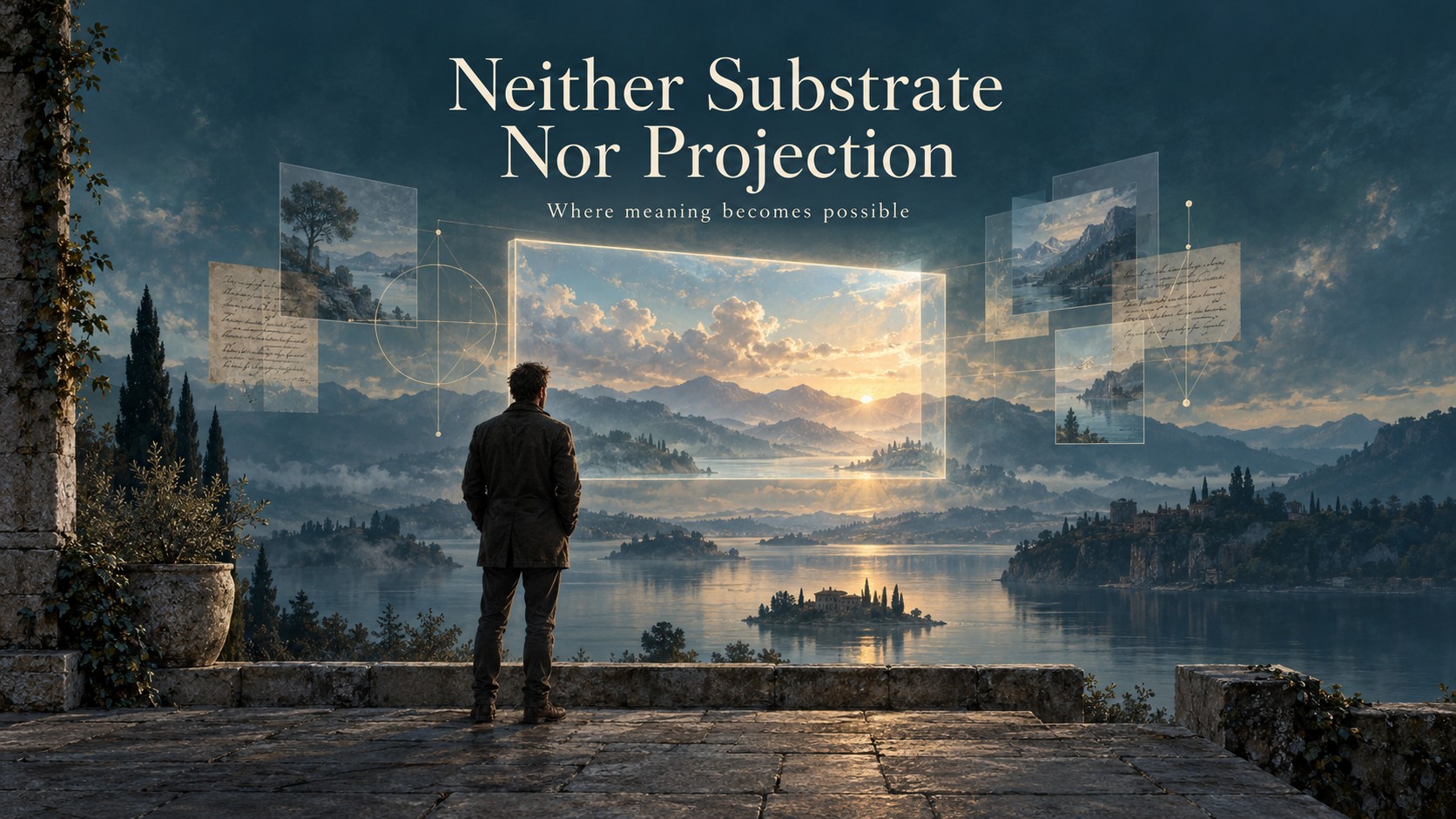

Neither Substrate Nor Projection
Cassirer, Ibn Arabi, and the space where meaning becomes possible
A picture appears in your feed. Before you have checked its source, it already feels like evidence. A sentence follows, and something uncertain begins to settle into a story.
What happened in that interval?
Something became meaningful. But did you discover its meaning, receive it from someone else, or participate in making it?
This is where Memecraft begins: with the relation through which something becomes distinguishable, matters to someone, and enters a livable world.
Two thinkers offer resources for understanding that relation: Ernst Cassirer and Ibn Arabi. Their differences matter as much as their similarities.
Cassirer: the forms through which we encounter a world
Cassirer’s philosophy of symbolic forms treats language, myth, art and science as different ways of articulating experience. Symbols do more than label things already fully understood. They help constitute the forms in which things become intelligible.
His movement from substance toward function changes the question. Instead of asking only what something is made of, we ask how relations make it identifiable and meaningful. His philosophy investigates the distinctive structures through which different symbolic forms accomplish this work. Ernst Cassirer — Stanford Encyclopedia of Philosophy
For Memecraft, this offers a way to investigate meaning without first claiming a final description of reality beneath all interpretation. It does not mean that every interpretation is equally valid. Interpretations remain answerable to evidence, coherence, context and consequences.
We can examine what a distinction enables, what a symbol gathers, and what a story makes visible—or conceals.
Ibn Arabi: distinction without absolute separation
Ibn Arabi approaches these questions within a theological framework. His expression huwa lā huwa, often rendered “He, not He,” holds together divine manifestation and the distinction between the Real and its manifestations.
His concept of barzakh, an isthmus or intermediate reality, likewise joins and separates. It helps describe a relation whose terms cannot simply be identified or completely disconnected. Imagination, khayāl, has a serious cognitive and ontological role within this account; it is not merely private fantasy. This account remains grounded in the divine Real. Ibn Arabi — Stanford Encyclopedia of Philosophy
Here Memecraft must state its borrowing carefully.
Initial State 1 can be read through the structure of barzakh. That is a proposed analogy, not an identification.
Memecraft borrows a relational structure without adopting Ibn Arabi’s theological ground.
Collapse and the reopening of a viewport
In this reading, Initial State 1 names a structural renewal: the reopening of a viewport through which something can become distinguishable. It names an event within the framework, not a substance beneath experience.
Collapse concerns the formation of a meaningful situation. It does not claim that human interpretation creates existence.
A face becomes a warning. A number becomes a loss. A sentence becomes an accusation. Something acquires a place within the world we are living.
Resonance names the lived weighting of that encounter: why this distinction matters to this person, with these memories, vulnerabilities and responsibilities. Something can resonate deeply and still be mistaken. Its felt significance gives us something to examine, not a guarantee of truth.
Distinction, resonance and symbolic articulation are aspects of a relation, not necessarily consecutive steps on a clock.
The realist objection
A realist can reasonably ask: if something resists interpretation, have we already acknowledged a reality beyond interpretation?
Yes: what we encounter exceeds our current description, and changing that description does not give us unlimited control over the encounter. What remains open is whether this establishes independence from mind as such.
That concession has a precise limit. Exceeding one description does not establish independence from every possible interpretation.
Resistance alone cannot settle that further question. A dream can resist our intentions. An inherited language can frustrate expression. An internal conflict can refuse resolution.
These examples do not refute realism. They show why resistance, taken by itself, cannot decide between competing accounts of reality.
Memecraft therefore acknowledges the limits of interpretation while keeping its own claim precise: collapse concerns how a world becomes available as meaningful. It does not explain existence into being, or settle what exists independently of us.
That openness defines the scope of the inquiry. It is not a completed answer to ontology.
Why the interval matters now
In the digital feed, an interpretation can arrive packaged with the image. The caption supplies the explanation; the comments supply the community; repetition supplies familiarity.
An AI-generated scene can move us without documenting an event. An authentic photograph can acquire a misleading meaning through its caption. Our response may be real even when our explanation of what prompted it is wrong.
The educational task is to make that formation available for examination.
What did I actually observe? What did the caption add? Why did this interpretation attract me? What evidence would lead me to revise it?
Memecraft calls the protected opportunity for such questioning the Pause, or Human Interval. Its connection with barzakh is an analogy developed here: keeping a distinction open long enough to examine the relation it establishes.
The Pause becomes productive when it leaves an authored trace: an account of what I noticed, accepted, questioned and changed. That trace gives reflection a form that can be discussed and defended.
Symbolic literacy means learning to notice how something becomes meaningful—and taking responsibility for the judgment that follows.
The world may exceed every account we give of it. We still have to answer for the accounts through which we live.
Poul Goldschadt — Memecraft · Digital Phenomenology